
The Indian Army just hit a major milestone. The 100th K9 Vajra howitzer gun rolled into service. The final unit of the first order arrived ahead of schedule. This is a big deal.
For decades, India's artillery wing ran on outdated equipment. The Bofors scandal of the 1980s froze modernisation. Soldiers made do with old guns while Pakistan and China modernised their own artillery.
The Indian Army Inducts All 100 K9 Vajra Howitzers changes that story completely.
The 100th gun is not just a number. It represents a shift in how India fights. Let me walk you through what this gun actually does, why the Army wants 300 more, and where the real limitations hide.
Wait, 91st Milestone? What Happened to the First 100?
You might have seen news about the "91st K9 Vajra T Gun."
Read Also: Pakistan Air Force Il-78 Escort for US-Iran Delegations
Here is the background.
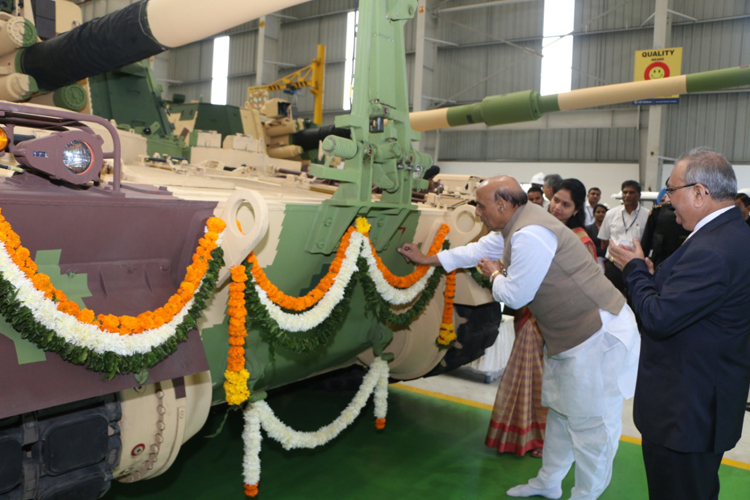
The first contract for 100 guns was signed in 2017 at a cost of roughly Rs 4,500 crore. Larsen & Toubro (L&T) built them in Hazira, Gujarat, under license from South Korea's Hanwha Aerospace.
Delivery finished in early 2021. Ahead of schedule. That rarely happens in defence procurement.
Then came the Galwan clash with China in May 2020.
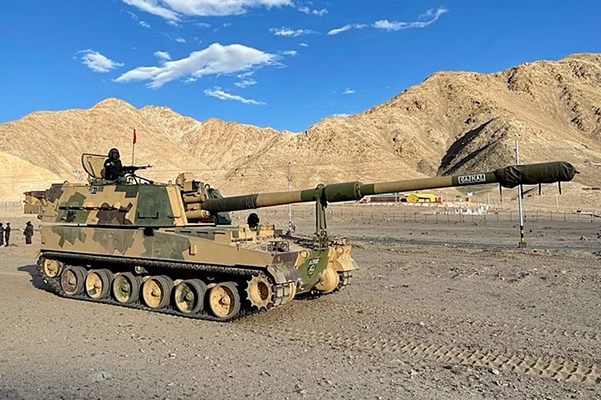
The Army urgently needed more firepower along the Line of Actual Control (LAC). They pulled some K9s from the Pakistan border and rushed them to Ladakh . The guns worked. Even in freezing high-altitude conditions.
So the government cleared a second order in December 2023 (formally signed in December 2024) for another 100 guns at Rs 7,600 crore.
The "91st milestone" refers to the 91st gun from this second batch being handed over. The full second order of 100 is now complete or nearing completion.
But the Army is not stopping there.
The Rs 23,000 Crore Bombshell: 300 More Guns Coming
Here is the news that broke just this week.
The Indian Army is preparing to seek approval for more than 300 additional K9 Vajra howitzers . The estimated cost? Around Rs 23,000 crore.
The proposal is expected to go before the Defence Procurement Board (DPB) this week.
If approved, this will be the largest artillery acquisition in decades. Total K9s in Indian service would cross 500 units.
Defence planners see this as essential for fighting on two fronts simultaneously—Pakistan to the west and China to the north. The K9 can handle both.
What Makes the K9 Vajra Actually Special?
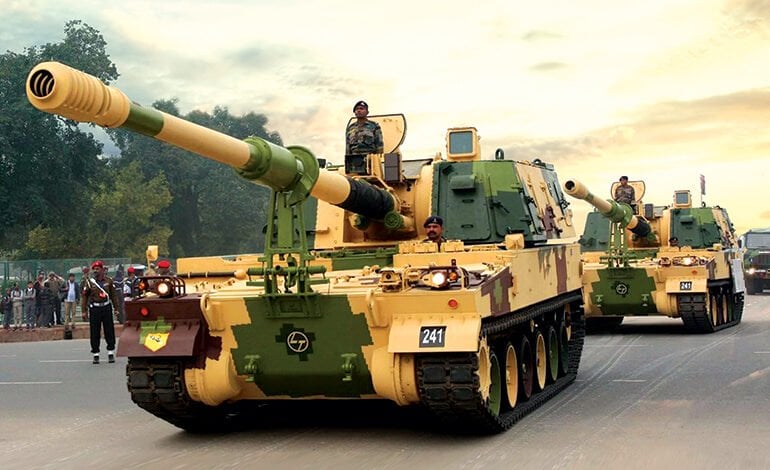
Let me break down the specs without the jargon.
Range: 40+ kilometres. That is not "maximum possible under perfect conditions." That is operational range. It can hit targets deep behind enemy lines.
Calibre: 155mm/52. That "52" means the barrel is 52 times longer than its width. Longer barrel means higher muzzle velocity. Higher velocity means more range and penetrating power.
You Must Also Like: Trump to Provide Ukraine With Patriot Air Defense Systems
Rate of fire: 6 to 8 rounds per minute in burst mode. Automatic loading system handles the shells. No crew member has to lift 40kg projectiles manually.
Multiple Round Simultaneous Impact (MRSI): Here is the clever part. The gun can fire shells at different trajectories so they all hit the target at the same time. The enemy gets no warning. One moment, nothing. The next, six shells arrive together.
Mobility: 67 km/h top speed. Operational range of 480 kilometres. It keeps up with main battle tanks.
Shoot-and-scoot: The gun can fire its first round within 30 seconds of stopping . It can fire while moving in under a minute. Then it relocates before enemy counter-battery fire arrives.
The Desert to Ladakh Jump: Why Terrain Versatility Matters?
Here is what impresses me most about this gun.
The K9 Vajra was originally designed for the Thar Desert. Pakistan border. Sandy. Hot. Flat.
Then the Army sent it to Ladakh. 15,000 feet altitude. Minus 20 degrees Celsius. Thin air. Mountain roads.
The gun worked anyway.
That is not supposed to happen. Most artillery systems are optimised for one terrain type. Desert guns overheat in the mountains. Mountain guns lose power in the heat.
The K9's 1,000 horsepower engine and advanced cooling system handle both extremes. The Army even developed winterisation kits for the Ladakh deployment.
This dual-terrain capability is why the Army wants 500 total units. One gun. Two fronts. No compromises.
Made in India: The Atmanirbhar Story That Actually Worked
Defence self-reliance is usually a joke. Not this time.
The first batch of 100 K9s had 50% indigenous content. The second batch targets 60%. Everything from fire control systems to communication gear to hull fabrication happens in India.
L&T's Hazira plant is now a full-scale tracked armoured vehicle manufacturing hub . They are not just assembling Korean kits. They are building.
When the next 300 guns get approved, expect that local content percentage to climb even higher.
The Operational Record: What Soldiers Actually Say?
Numbers on paper mean nothing. Real battlefield performance is everything.
The K9 has been tested in two major exercises that matter.
Exercise Agni Varsha in the Thar Desert involved the Southern Command. Defence journalists from 25 countries watched K9 units fire, displace, and reposition. The rhythm of the entire manoeuvre depended on the K9's speed.
Ladakh deployment after Galwan proved high-altitude capability. The Army moved a full regiment of K9s to eastern Ladakh . They performed "satisfactorily" according to defence sources.
The K10 ammunition resupply vehicle—also part of the ecosystem—carries 104 rounds and transfers them at 12 rounds per minute . A K9 without ammunition is just an expensive metal box. The K10 keeps it fighting.
What the Brochure Does Not Tell You?
Let me be straight about the problems.
Cold weather still needs work. The Ladakh deployment required winterisation kits. The base gun was not designed for extreme cold. The Army had to retrofit.
Weight is high. At nearly 50 tonnes, the K9 cannot go everywhere. Some mountain roads and bridges cannot handle it. Air transport is difficult.
Logistics tail is substantial. A tracked self-propelled gun drinks fuel. It needs heavy recovery vehicles if it breaks down. The K10 resupply vehicles add to the convoy size.
Counter-battery vulnerability is real. Yes, shoot-and-scoot helps. But modern radar-guided counter-battery systems are getting faster. The window to displace is shrinking.
Cost per gun is high. At roughly Rs 75 crore per gun for the latest batch, you cannot flood the border with these. They are precise instruments, not area weapons.
Who Is the K9 Vajra For? (And Who Should Use Something Else)
Let me give you practical guidance.
The K9 is best for: Open terrain warfare. Desert sectors. Plains. Areas where mobility and rapid displacement matter. Armoured formations that need organic fire support.
Who should look elsewhere: Mountain-focused armies (lighter towed guns work better). Budget-constrained forces (a mix of towed and wheeled SPGs gives better coverage)
What the Next 300 Guns Mean for India's Artillery?
If the Rs 23,000 crore proposal gets approved, here is what changes.
Two-front coverage becomes real. Right now, the Army has to prioritise. Enough K9s on both borders simultaneously changes the calculus.
Regimental structure upgrades. Artillery regiments get modernised faster. The older 105mm and 122mm guns finally get replaced.
Industrial base expands. L&T's Hazira plant ramps up production. Supply chains deepen. Export possibilities open up.
Deterrence improves. China and Pakistan know what a K9 can do. 500 of them along the borders sends a message.
The Final Thoughts
The Indian Army Inducts All 100 K9 Vajra Howitzers is not the end of the story. It is the beginning. The first 100 proved the concept. The second 100 demonstrated confidence. The planned 300 more show strategic intent.
This gun works in the desert. It works in the mountains. It fires fast. It moves faster. It is made in India. The limitations are real cold weather performance needs work, weight restricts some deployments, and cost limits quantity. But for what it is designed to do, the K9 Vajra delivers.
Twenty years ago, India's artillery was a museum piece. Today, it has one of the most capable self-propelled howitzers on the planet. The 100th gun is in service. The 200th is coming. The 500th is on the drawing board.
Pakistan and China are watching. They should be.