
Here is the real breakdown. The Indian Navy is building something that changes the game entirely. Project 18 is not another incremental upgrade. It is a complete rethinking of what a destroyer should be.
The project 18 next generation destroyer specifications show a vessel that weighs over 13,000 tonnes, carries 144 vertical launch system cells, and uses integrated electric propulsion. These are not small numbers. They represent a fundamental shift in how India plans to fight at sea.
The design phase will take about five years. Contract signing and delivery will take another five to ten years after that. This is a long-term project, but the ambition is clear.
Why are they building this? The Indian Ocean is becoming increasingly contested. China's naval expansion is real. The Type 055 destroyers are already in service. Project 18 is India's answer to that challenge. It is not about matching numbers. It is about building a warship that can dominate its environment.
Let me walk you through what this ship actually does.
What Is Project 18 Exactly?
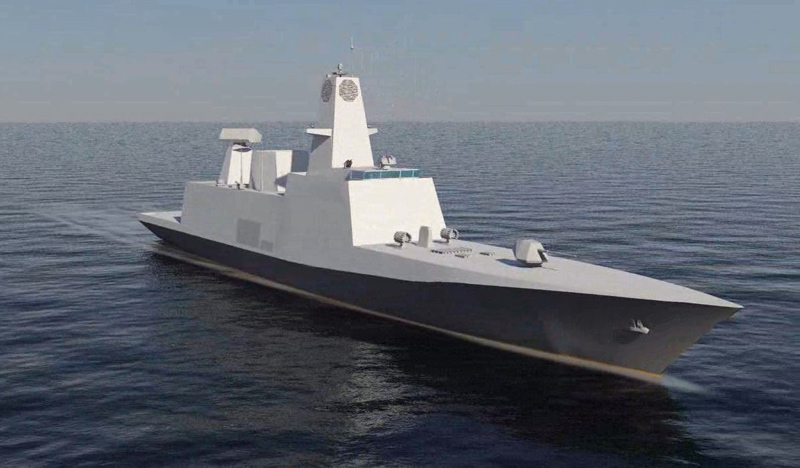
Project 18 is the Indian Navy's Next Generation Destroyer programme. It follows the Visakhapatnam-class destroyers currently in service. The Warship Design Bureau is handling the design work.
Read Also: Russian Ship With Nuclear Reactors Sinks at Sea
The initial plan called for four to six ships. Some reports suggest up to eight ships in two batches. The total contract value sits around $8–9 billion. Each ship will cost at least ₹17,570 crore. That is a serious investment in naval capability.
What makes this programme different? The scale. The technology. The ambition. This is not a slightly bigger destroyer. It is a cruiser by international standards. India does not operate cruisers today. Project 18 changes that.
Project 18 Destroyer Displacement: Why 13,000 Tonnes Matters
Let me talk about weight first because it tells you everything.
The project 18 destroyer displacement figures vary. Wikipedia cites 10,000 tonnes standard displacement. Other sources push full-load displacement to 13,000 tonnes. The Visakhapatnam-class sits around 7,400 tonnes. Project 18 is roughly 3,000 to 4,000 tonnes heavier than that.
What does that mean operationally? Greater displacement gives you more VLS cells. It allows for larger radar arrays. It provides better sea-keeping in rough conditions. It extends your range. It gives you space for the advanced combat systems you actually need.
The ship's length is expected to reach approximately 180 metres. That is longer than a football field. You need that length to accommodate the weapons, sensors, and propulsion systems this ship carries.
Project 18 Destroyer VLS: Breaking Down the 144 Cells
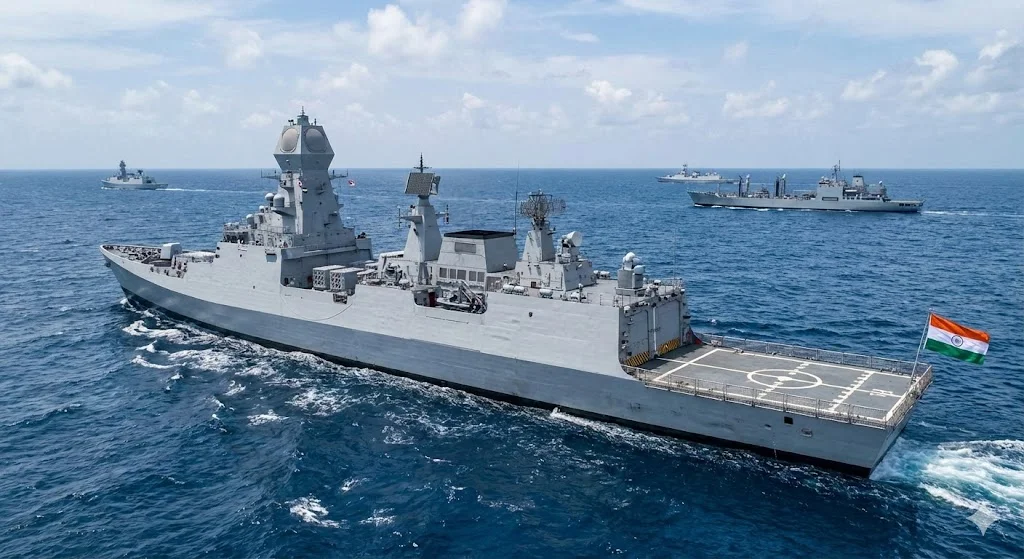
This is where things get interesting.
The Project 18 destroyer VLS count stands at 144 cells. That makes it one of the most heavily armed surface combatants in Asia. The breakdown of those cells tells you exactly how the Navy plans to fight.
You Must Also Like: Secretary of the Navy Speaks at WEST 2026 Conference
Aft section: 32 cells for the PGLRSAM. This is a long-range surface-to-air missile with a range of 250 kilometres. It intercepts aircraft and ballistic missiles. It provides the outer layer of defence for the ship and its battle group.
Midship: 48 cells for BrahMos extended-range supersonic cruise missiles. These are dual-use weapons. They can engage surface ships or strike land targets. The range sits around 800 kilometres for the extended-range variant.
Forward section: 64 cells for very short-range surface-to-air missiles. These provide the final defensive layer. They take out incoming threats that have penetrated the outer defence.
Hypersonic weapons change the game completely. They fly at Mach 5 and above. They are extremely difficult to intercept.
Project 18 surpasses that number. Whether that translates to superior combat effectiveness depends on the quality of the missiles and the combat system integration. But the raw capacity is undeniable.
Project 18 Destroyer Design: Stealth and Survivability
The Project 18 destroyer design prioritises stealth above everything else.
The Warship Design Bureau has incorporated low-observable features throughout the hull and superstructure. The goal is simple. Reduce the radar cross-section. Make the ship harder to detect and track at long ranges.
The integrated mast combines multiple sensors into a single structure. This is not just about efficiency. IEP generates the massive electrical power required for advanced radars, directed-energy weapons, and future combat systems. It also reduces acoustic noise. Quieter ships are harder for submarines to track.
The ship is expected to feature extensive automation. This reduces crew requirements by 25 to 30 per cent compared to existing platforms. Fewer crew members mean lower operational costs. Smaller crews are easier to protect in combat. They are also harder to replace if casualties occur.
Sensors and Radar: Seeing Beyond 500 Kilometres
You cannot shoot what you cannot see. Project 18 addresses this with a sensor suite that ranks among the most advanced in the world.
The ship will feature four large Active Electronically Scanned Array radars integrated into the superstructure. These include an S-band active array as the primary radar, a volume search radar, and a multi-sensor mast. The system provides 360-degree surveillance and tracking of aerial and surface threats.
The Long-Range Multi-Function Radar is being developed by DRDO. It is expected to detect and track threats at ranges exceeding 500 kilometres. This gives the ship and its battle group early warning against incoming missiles and aircraft.
The sensor suite is not just about detection. It integrates with the combat management system to provide a complete picture of the battlespace. The ship can direct unmanned aerial vehicles, unmanned surface vessels, and extra-large unmanned underwater vehicles. It acts as a command hub within a carrier battle group.
Propulsion: The Shift to Integrated Electric Power
The Project 18 next generation destroyer specifications include an Integrated Electric Propulsion system. This is one of the most significant design choices in the programme.
This arrangement offers several advantages over traditional mechanical propulsion. First, it provides greater fuel efficiency across different speeds. Ships spend most of their time cruising, not sprinting. IEP is more efficient at cruising speeds.
Second, it generates the massive electrical power needed for advanced sensors and weapons. Modern warships consume enormous amounts of electricity. IEP delivers that power.
Third, it reduces acoustic signature. Electric motors are quieter than mechanical drive systems. Quieter ships are harder for submarines to detect.
Fourth, it supports future integration of directed-energy weapons. Laser weapons in the 50–100 kW class are expected to be integrated for counter-drone and missile defence roles. These weapons require substantial electrical power. IEP can provide it.
One limitation worth noting is the complexity of IEP systems. They are relatively new in naval applications. They require careful maintenance. The Indian Navy will need to develop the technical expertise to keep these systems operational over the ship's service life.
Project 18 Destroyer How Many Will Be Built?
The Project 18 destroyer how many question has seen multiple answers over the programme's development.
Initial plans suggested an initial batch of four to six ships. Other reports indicate between six and ten ships may be built initially. The possibility of expanding to 24 over the coming decades has also been mentioned.
The programme is expected to proceed in two batches of four ships each. Construction will be split between Mazagon Dock Shipbuilders Limited and Garden Reach Shipbuilders & Engineers. This spreads the workload across India's two major warship builders.
The total contract value is estimated at around $8–9 billion for eight ships. Each ship is estimated to cost at least ₹17,570 crore. This represents a significant investment in India's naval capabilities. It reflects the strategic importance of the programme.
Project 18 vs Visakhapatnam-Class: A Generational Leap
Comparing Project 18 with the Visakhapatnam-class destroyers highlights just how significant this programme is.
The Visakhapatnam-class displaces 7,400 to 8,200 tonnes. Project 18 displaces 10,000 to 13,000 tonnes. That is a massive difference.
The Visakhapatnam-class carries 48 VLS cells. Project 18 carries 144. That is triple the firepower.
The Visakhapatnam-class uses conventional propulsion. Project 18 uses integrated electric propulsion. That changes the entire power and thermal management equation.
The Visakhapatnam-class has moderate stealth. Project 18 has advanced low-observable design. That makes it harder to detect and track.
The numbers tell the story. Project 18 is not an incremental improvement. It is a completely new class of warship that redefines what the Indian Navy can achieve.
What This Means for Indian Naval Strategy
Project 18 is not just about building bigger ships. It is about projecting power across the Indian Ocean Region and beyond.
The destroyers will complement and strengthen India's existing aircraft carrier battle groups. These include the groups led by INS Vikramaditya and INS Vikrant. Project 18 destroyers will provide the layered air defence and offensive strike capability that carrier groups require to operate in contested environments.
The programme also supports India's Aatmanirbhar Bharat initiative. Approximately 75 per cent of components are expected to be indigenously sourced. This reduces reliance on foreign military technology. It builds domestic defence manufacturing capability. It creates jobs and expertise in India's defence industrial base.
Final Thoughts
The project 18 next generation destroyer specifications reveal a warship designed to compete with the best in the world. At 13,000 tonnes with 144 VLS cells, integrated electric propulsion, and advanced AESA radars, it represents a generational leap for the Indian Navy.
But warships are not built on specifications alone. The success of Project 18 will depend on execution. Can the Navy manage the technical complexity? Can the shipyards deliver on time and within budget? Can the crew be trained to operate these advanced systems effectively?
These are questions only time will answer. What is certain is that Project 18 signals India's intent to build a navy capable of operating at the highest levels of maritime warfare. For anyone tracking naval power in the Indo-Pacific, this is a programme worth watching closely.
The ship is not yet in the water. But the plans are on the table. The design is maturing. The ambition is clear. Project 18 is coming. And when it arrives, it will change the balance of power in the Indian Ocean.